GAMABA Artist - Lang Dulay
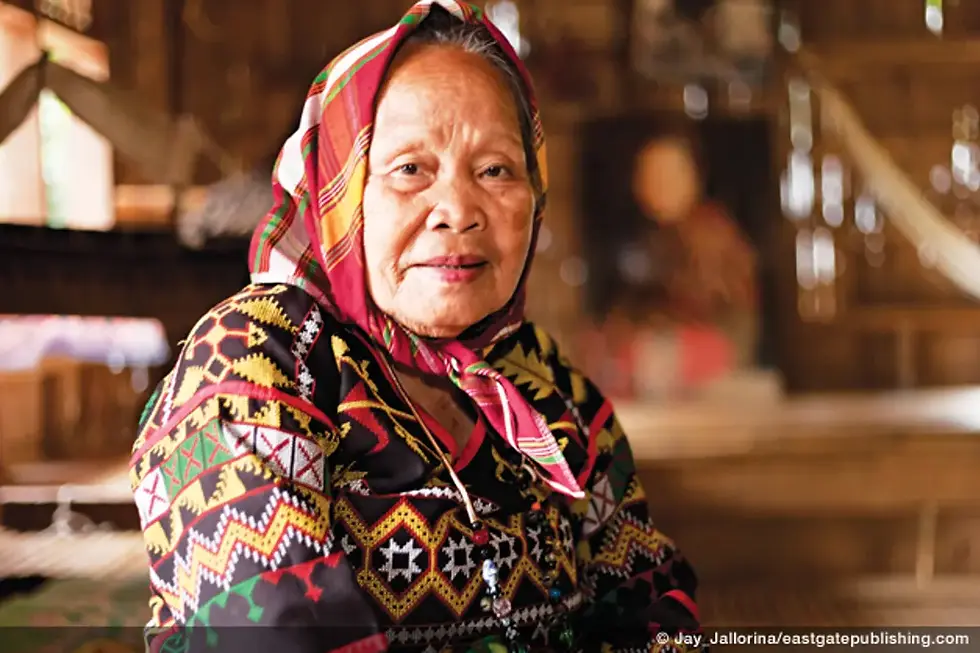
About Lang Dulay.
Lang Dulay, regarded as one of the Philippines’ National Living Treasures since 1998, is known as the T’nalak Master Weaver who knows more than a hundred weave pattern and designs, including the bulinglangit (clouds), the bankiring (hair bangs), and the kabangi (butterfly). Born on August 3, 1928 as a T'boli princess from the Lake Sebu region in South Cotabato, she first learnt the art of weaving at the age of 12 from her mother, Luan Senig. Some of her designs were based on her actual dreams, hence her description as a “dreamweaver”.
As a major contribution in her lifetime aspiration of promoting the traditional art of T'nalak weaving, she successfully set up the Manlilikha ng Bayan Center workshop in Sitio Tukolefa, Lamdalag, Lake Sebu. By 2014, five of her grandchildren also became weavers like her. At the age of 86, Lang Dulay fell into coma and died. However, her works of art remain in the hearts and minds of those who she inspired in weaving. At present, she is continuously recognized as a recipient of a “Gawad sa Manlilikha ng Bayan (GAMABA)” by the National Commission for the Culture and the Arts (NCCA).

Her Contribution
Lang Dulay represents a continuity of tradition for the people in Lake Sebu. It carries the identity for the T’boli tribe, a history-driven tradition that has withstand the ages of modernity. President Ramos conferred her the title of National Living Treasure in 1988, signifying the impact of her crafts to the preservation of textile weaving specific to the T’boli.
Her hands are responsible for the replication of her native expression; images of her mother tribe as seen through the butterflies, crocodiles, and flowers, as well as intentional lines reflecting the bodies of water carving through the majestic Lake Sebu—she never falls short of ideas that brim with a narrative waiting to be told. Her art is also a testament of resistance, where art is industrialized and textile has been reproduced through mass production, it is these crafts that remind us of the intricacies of their cultural past, and remind us that technology and modernity does not equate cultural progress.
About Lang Dulay's Creation
Get to know more about her works

T'nalak and The T'boli Tribe
T’nalak serves several purposes for T’boli tribe. T'nalak is traditionally woven to celebrate significant life events for the members of the tribe, such as marriage and birthdays and is used during ritual events. Economically, weaving became the primary source of income for the T’boli tribe. Furthermore, it indicates one's social class and individual status.
What is T'nalak?
T'nalak, a hand-woven cloth made from abaca fibers, is one of the Philippines' most well-known cultural products. The textile is traditionally woven by women with royal blood who belong to the indigenous tribe of T'boli. The exquisite designs of the T'nalak have been passed down from generation to generation. Black, red, and white are the colors that make up the designs of the cloth, and they are used, respectively, for the background, relief elements, and patterns. T’nalak patterns are believed to be based on images brought down by the abaca guardian spirit, Fu Dalu, and witnessed by T'boli ancestors in their dreams. As a result, T'nalak weavers are known as dream weavers.

The Beauty in T'nalak making
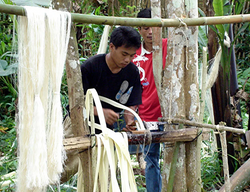
T'nalak weaving is a labor-intensive process that normally takes months to be completed. The men of the tribe first harvest the abaca tree's fibers, which are then torn apart in a procedure known as kedungon. The fibers will then be washed, dried, and knotted to create a material that resembles a thread. The natural dyes obtained from the leaves, roots, and barks of the trees are used to color the abaca fibers into the three traditional colors of T'nalak. Once properly dyed, the abaca threads are then weaved on a T'boli backstrap loom or a legogong. For the last step, the cloth is thoroughly cleaned in a river before drying and burnishing.
 |  |  |
|---|
Learn more about the process of T'nalak Weaving:
To proceed to the exhibit of Lang Dulay's Famous works, click the button below:

ABOUT GAMABA
The Dreamweaver

Lang Dulay was awarded by the National Commission for the Culture and the Arts (NCAA) as the National Living Treasure in 1988 for her contribution to preserving the T’boli culture and identity through her outstanding artistry of the T’nalak cloth.
TEAM MEMBERS
Marchelle Fenol
Jericho Gamara
Joyce Gatdula
Camila Golloso
Monique Hautea
Gleiza Ho
Rya Aikester Labo
